Archive for April, 2008

Episode #14 - Getting that Mower Going!

User ImageThe Handyguys April 24th, 2008

 
icon for podpress  Standard Podcast [23:36m]: Play Now | Play in Popup | Download

The Handyguys discuss annual spring maintenance for your lawn mower

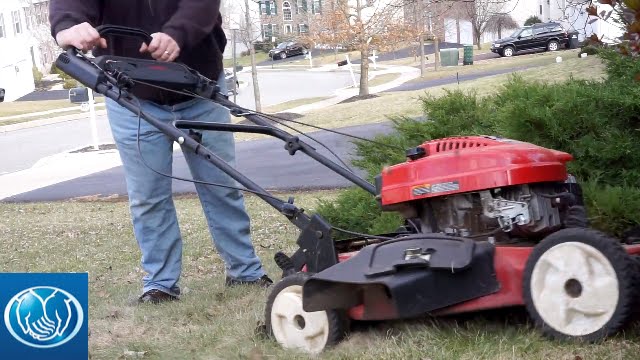
For many of us in the northern parts of the USA, it is that time of year when we get the lawn mower out for the first time. Most of us probably use tradition walk behind mowers with combustion engines. Like our cars, these tools require maintenance to keep them humming along from year to year. The Handyguys discuss how you can handle these basic maintenance items yourself:

We start off by talking about mower safety and some crazy mower stories before we get into the basics of spring mower tune-up.

Basic Spring mower tune up consists of checking and maybe replacing the spark plug, cleaning or replacing the air filter, sharpening your blade, cleaning the deck and changing the oil.

This is an example of a bad sparkplugChanging the spark plug – The spark plug only needs to be changed if its black, burnt, or damaged. If it looks clean when you remove it only replace it if you are having trouble with the mower running smooth or not starting. This picture is an example of a badly fouled plug that needs replaced.

This filter could likely be cleaned with compressed air or a brush. I chose to just replace it.Replacing an air filter – make sure you get the correct air filter. There are many sizes and styles. The filter can be cleaned with compressed air or a brush. If its really bad just go ahead and replace it. Some filters are foam and can be washed in warm soapy water. Do not re-install a washed filter until its completely dry.

Sharpen your mower bladeSharpening a blade – You can use a file or a grinder to sharpen your blade. Make sure you use the same angle as the previous sharpening. Handyguy Brian got this heavy duty grinder for only $25, including the stand, at an auction. An inexpensive grinder will be fine for this task. A Dremel tool or even just a plain old file will do the trick as well. A sharp blade makes a better cut and helps keep your grass healthy.

Clean the grass and removing the mower bladeCleaning the mower deck – Sorry I don’t have an after picture. Use a scraper and a wire brush to clean up the mower deck. This is especially important for mulching mowers. If you have rust, sand that and hit it with some primer and paint.

Changing the oil – Do this every year. Make sure you use the proper oil and the correct amount. Most mowers will use SAE 30 oil. Do not use 10W-30, its different and will likely void any warranty you may have. Regardless – Check your owners manual first for the correct oil.

Learn more by listening to this installment of the Handyguys Podcast!

And remember – You can always ask The Handyguys a question about your DIY or home improvement project by calling us at (615) 676-0877 or using the contact form.

We respond to all questions and may use your question in a future episode.

Our podcasts are made possible through revenue at our store. Our store is a partnership with Amazon. Some of our favorite tools are listed here


Sphere: Related Content

Episode #13 - The Cold Water Heater

User ImageThe Handyguys April 17th, 2008

 
icon for podpress  Standard Podcast [32:22m]: Play Now | Play in Popup | Download

The Handyguys answer questions about Hot water heaters (or is it “cold water” heater?) and discuss basic water heater maintenance.

Please note: The Handyguys apologize for some technical difficulties which led to a broadcast with some snap, crackle and pops. We expect next week’s podcast to have this problem corrected.

Natural Vent gas hot water heaterBasic components of a water heater, T&P, expansion tank, water supply, gas lineGas Valve and drain valveGas shut-off valveBrian and Paul discuss the maintenance of your hot water heater. Everyone owns one but you don’t always get instructions on how to maintain the heater in your home. We just expect it to work and it usually does. However, every hot water heater will fail at some point and you will typically discover this one day when you have to settle for a cold shower. Even worse, you end up with water leaking all over your basement floor from the hot water tank.

The Handyguys own gas water heaters but much of what they discuss in this episode applies to both electric and gas water heaters.

T&P ValveThermocouple, Pilot and ignitionWhat are the key components of a hot water heater? How do you maintain the heater? Are there maintenance tips to prolong the life of our heater and avoid the expensive plumber bill? The Handyguys discuss these basic questions in the first half of the podcast. In addition to basic water heater maintenance, a sad story about an electrocution caused by a faulty water heater is discussed.

The Handyguys also answer a couple listener questions about finicky gas hot water heaters with pilot lights that keep going out. Check out this weeks podcast on hot water heaters.


As always - you can click on a thumbnail image for a full size view. If you like our podcasts please consider shopping in our Amazon store for your next online purchase or support our advertisers. Thanks - The Handyguys

Sphere: Related Content

Episode #12 - Katrina Update

User ImageThe Handyguys April 10th, 2008

 
icon for podpress  Standard Podcast [30:20m]: Play Now | Play in Popup | Download

Fixing Homes in Mississippi Gulf - Bay St. Louis

The Handyguys start off with a reminder of their contact information: Use the contact us tab on the website, call 615-676-0877 or email us@handyguyspodcast.com.

On August 23rd, 2005 hurricane Katrina came through Bay St Louis, MS with about a 30′ tidal storm surge and 100+ MPH winds. The area was devastated. New Orleans got most of the media coverage in the days after the storm but small cities along the coast, like Bay St. Louis ,were hit even harder.

The Handyguys have done volunteer work, post Katrina, in partnership with Lagniappe Presbyterian Church (PCA). We are taking a time out from our regular style podcasts to do an interview with Curt Moore from Lagniappe. Please listen to this podcast to hear this featured interview with Curt Moore, Associate pastor and Disaster Relief Coordinator for Lagniappe.

Curt describes Bay St. Louis before Katrina and then explains what it was like after the storm. He also explains how Lagniappe church got started and provides a status update of how the area is coping two and a half years after the storm. To date Lagniappe has built 28 new houses in addition to the many houses they have repaired or restored.

Curt describes planting a church that includes a construction company, hotel, restaurant and travel agency in addition to a place to worship! Lagniappe has the capacity to house, feed and manage 350 volunteers per day for rebuilding efforts. The church ministers to people’s physical and spiritual needs. Curt describes this concept as “Participating in the declaration and demonstration of the Gospel”.

Brian had the opportunity to help out with two houses affectionately referred to as the “twins” because they share an identical footprint and are located in adjacent lots. Their configurations are slightly different. House one is a three bedroom one bath. House two is a 3 bedroom two bath. House one has a much larger porch, house two has more interior square feet. Below are a few pictures from Brian’s recent trip.

Two new houses affectionately referred to as the twinsthetwins1.JPGthetwins2.JPGthetwins3.JPGthetwins3b.JPG

Please also take some time out to view a brief movie about Lagniappe

http://www.maxcast.com/lpcvideos

If you are interested in bringing down a team please do so. Contact Cammie Chapman for Reservations, group sign-up, etc. Additional Information for teams is also available.

Remember - if you like listening to the Handyguys please consider supporting us via purchases at our store.

Sphere: Related Content

Episode #11 - A Step Up

User ImageThe Handyguys April 3rd, 2008

 
icon for podpress  Standard Podcast [25:42m]: Play Now | Play in Popup | Download

The Handyguys answer a question about using bondo on rotted wood and they discuss the different varieties of ladders.

The Handyguys Brian & Paul answer a question about using Bondo for wood repairs submitted by Moe.

Question

My house was built in the late 70’s and lately I’ve noticed that some of the windowsills (exterior) have patches of rot. Replacing a windowsill seems like it might be beyond my expertise so I’m wondering about removing the rot and filling it with something. I’m told Bondo is a bad idea. Do you have any recommendations on what to use and how to tackle a job like this?”

Thanks for contacting us Moe. This is a great question.

The Handyguys start off discussion what Bondo is and how it can be used for wood repair applications.

Below are excerpts of The Handyguys email responses to Moe. More details are available in the podcast.

My first inclination is to replace the rotted wood. Weather or not you need to do this depends on the extent of the damage. Feel free to email us a few pictures and we can give you a better assessment. In my opinion replacing the wood is actually easier and looks significantly better when done. I sometimes have trouble making a patch disappear after I paint. If replacing the wood is definitely out then you have a few general steps.

1) Remove ALL loose wood, rotted wood, dust and debris. If you do not get out the rot it may continue deeper. A tool like a Dremel can help with this along with scrapers, utility knives and so forth.
Dremel
http://www.handyguyspodcast.com/the-handy-guys-store?B0000302XV
Carving Bits
http://www.handyguyspodcast.com/the-handy-guys-store?B00005LEXW

2) Harden remaining fibers
There are products made for this such as
http://www.handyguyspodcast.com/the-handy-guys-store?B000BPINKS
Or, if you had a ready supply of Cyanoacrylate (super glue) you could use that to harden the fibers (the liquid type, not the gel)

3) Fill with exterior grade wood filler such as
http://www.handyguyspodcast.com/the-handy-guys-store?B000BQL0WA

4) Sand smooth

5) Prime and paint

The hard part is when you have edge details or unusual shapes.

I have never used Bondo but I do not see why your couldn’t as long as you went through getting the old rot out and hardening the fibers first.

Handyguy Brian

And Paul’s 2cents

Moe,

Just to piggy back on what Brian already said. I have used bondo on exterior wood applications and I like it. I used the version that is sold in the paint section of the big box stores for just this application. I think it is the same as the auto version.

I have used Bondo on a rotted porch post. I cleaned out as much rot as possible and applied the Bondo. It hardens fast so you have to get used to it. In my opinion Bondo works better for exterior applications then most other wood fillers for this purpose.

My porch posts have held up great. Make sure you prime and paint after it hardens. You can do this same day I believe because it hardens so fast.

Here is a link to Bondo for wood. (Sorry, its not available in our store)

http://www.3m.com/US/auto_marine_aero/Bondo/catalog_item27aa.html?itemNbr=119

Good Luck,

Handyguy Paul

The Handyguys then go on to speculate that Moe may need to work from a ladder and realize that they didn’t include ladders in their home toolkit show. This evolves into a discussion about various types of ladders.

Types of ladders discussed

Typical A frames in fiberglass, wood and aluminum. Paul likes the ones with fancy attachments.

Extension ladder pros and cons in fiberglass, aluminum and wood are discussed.

Brian likes the Little giant type

Little Giant Ladder

http://www.handyguyspodcast.com/the-handy-guys-store?B0000224MC

Paul highly recommends a ladder stabilizer with any extension ladder.

Ladder stabilizer

http://www.handyguyspodcast.com/the-handy-guys-store?B0000224MC

Sphere: Related Content