Archive for February, 2008

Episode #7 - Broken Glass

User ImageThe Handyguys February 28th, 2008

 
icon for podpress  Standard Podcast [33:38m]: Play Now | Play in Popup | Download

The Handyguys discuss fixing windows, answering a question from a listener regarding the repair of glass on a modern vinyl window. But before dealing with that issue, the Handyguys discuss covering the glass with window films.

There are two major window film products. Many of you have probably seen the product that covers the entire window unit to block air leaks during the cold winter months. You put up the plastic sheeting with double-sided tape and heat it up with a hair dryer to pull it taut. These work fairly well for older leaky windows. Another product is the Gila window film that is applied to block UV rays and to provide interesting decorative looks for your windows. The Handyguys understand how the Gila film could aid a home in the heat of the southwest, but does this product really pay off in the north? Let us know what you think.

Bob from Tacoma, WA, asks the Handyguys how to repair a modern vinyl window that has been broken from an unknown projectile.Fixing a new vinyl window is a lot different than replacing the old wood windows we grew up with. You can’t just go down to the hardware store and get a new piece of glass. The new windows typically use a double (or triple) glass window unit with faux dividers that snap in between the glass or on the surface. Some older vinyl windows are not repairable when broken. Your only option is to completely replace the sash. Fortunately, with most newer windows, the glass is removable by removing the stops. The pictures below document this process. Listen to the podcast for more details.

Modern Vinyl Window Repair

Remove sash

Remove Sash Removing the sash part 2

Remove the stops

Removing the Stops continued Stops coming offRemoving the Stops continuedRemoving the Stops continued

Replace the glass

(Handyguy Paul is showing us on a window he already fixed, so no pictures of this part.)

Reinstall the stops

Replacing the stops

Wood Frame Window Repair

As far as fixing glass on a older windows, Brian gives us a lesson in glazing windows:

Gather your tools — a 5 in 1 tool, utility knife, scraper, heat (maybe).

Getting Ready

Remove old glazing

You may need to apply heat to get it out. A 5-in-1 tool is also helpful.

Remove old glazing

Remove glazing points with utility knife or needle nose pliers.

Remove old glazing points

Remove glass; scrape and remove glazing that glass was set in.

Frame clean and ready

Prime any bare wood with oil based primer or boiled linseed oil.

Prime the frame

Get new glass from hardware store, measured to size. You want glass to be about 1/8″ smaller than the opening to allow for expansion.

Now do everything in reverse.

Put a thin bed of glazing compound on sash to set glass onto. Brian always uses Dap 33. You must knead it to warm it up. Get your hands into it.

knead the puttyPut some putty on the frame where the glass will sit

Put glazing points around glass.

For smaller panes, you only need about one or two points on each side.

Insert glazing points

Glaze

Reach into the can of Dap 33 and pull out about a golfball-sized wad of glazing; roll it into a ball and knead it around a little so that it is more workable. Then roll it in your hands to form a long snake.

Knead and roll out a worm of putty

Run the glazing around the edges of the of the glass.

Press putty into frame

Draw off excess.

Use a 1-inch stiff putty knife to draw off excess putty and make a smooth bead of putty around edges of the window mutton and the pane of glass. This takes a little practice.

Draw putty smooth with knifeRemove excess puttyCorners are hardestDone

And Brian has another story about a funny incident at the hardware store… fortunately there is no blood in this story.

Sphere: Related Content

Winner

User ImageThe Handyguys February 28th, 2008

 
icon for podpress  Standard Podcast [2:29m]: Play Now | Play in Popup | Download

Thanks to all those who responded to our question about WD-40. The winner is Michael B.

WD-40 with smart straw

Michael will receive a Smart Straw can, a Big Blast can, and a No-Mess Pen — all compliments of WD-40. We will be providing a review of the new Smart Straw on a future episode. Maybe Michael will also give us his feedback.

Oh, and I almost forgot. What does WD-40 stand for? From the WD-40 site…

“WD-40 literally stands for Water Displacement, 40th attempt. That’s the name straight out of the lab book used by the chemist who developed WD-40 back in 1953. The chemist, Norm Larsen, was attempting to concoct a formula to prevent corrosion-a task which is done by displacing water. Norm’s persistence paid off when he perfected the formula on his 40th try. “

Sphere: Related Content

Episode #6 - The Tool Kit

User ImageThe Handyguys February 21st, 2008

 
icon for podpress  Standard Podcast [25:33m]: Play Now | Play in Popup | Download

In this show, The Handyguys detail the basic Handyguy Toolkit that every homeowner should have. We also have our first free giveaway contest. Listen to the podcast for details.

But first The Handyguys discuss a new Mantis Cordless Reel Mower. This new battery-powered mower weighs only 25 pounds and is powered by a 24-volt NiCad battery, which provides enough power to mow up to 2,500 square feet of lawn. This mower runs quietly and is environmentally friendly, according to the company.

But what do The Handyguys think of this product? We have to be honest, we haven’t used it and aren’t exactly sure how it works. However, when he was a kid, Brian used a traditional reel mower to mow almost an acre of grass at his grandmother’s house. Sure it was hard work, but he did not do any damage to the environment with it. (But what about those chemicals you spread on the lawn Brian?)

Check out the Mantis Cordless Reel Mower before spring, or check out this no-carbon producing reel mower to satisfy even the pickiest environmentalist requirements.

Since the grass is dormant in most parts of the country, we should be discussing tools, not mowers. The Handyguys tackle the job of listing the essential tools that should be in every homeowners toolbox.

Listen to the podcast for details.

The Handyguys starter toolbox:

  1. Assortment of Phillips-head and flathead screwdrivers
  2. 16oz hammer
  3. Bosch drill
  4. Adjustable wrench
  5. Pliers (needle nose, diagonal cut, regular)
  6. Vice grips (Made in USA)
  7. Alan wrench set
  8. Tape measure (25′ )
  9. Utility Knife
  10. 2′ Level
  11. Wonder bar crowbar
  12. Leather gloves
  13. Stud finder (Electronic) or (Magnetic)
  14. WD-40
  15. Flashlight
  16. Bucket Boss
  17. Duct tape!!! (or is it duck tape?)

Let us know what you recommend for the basic Handyguy Toolkit. We may mention it on our show.

Finally, the Handyguys have their first contest. We will be giving away something for free. All you need to do is listen to this podcast to find out what it is and how to enter our contest to win.

Sphere: Related Content

Episode #5 - Compress It!

User ImageThe Handyguys February 14th, 2008

 
icon for podpress  Episode #5 - Compress It! [29:46m]: Play Now | Play in Popup | Download

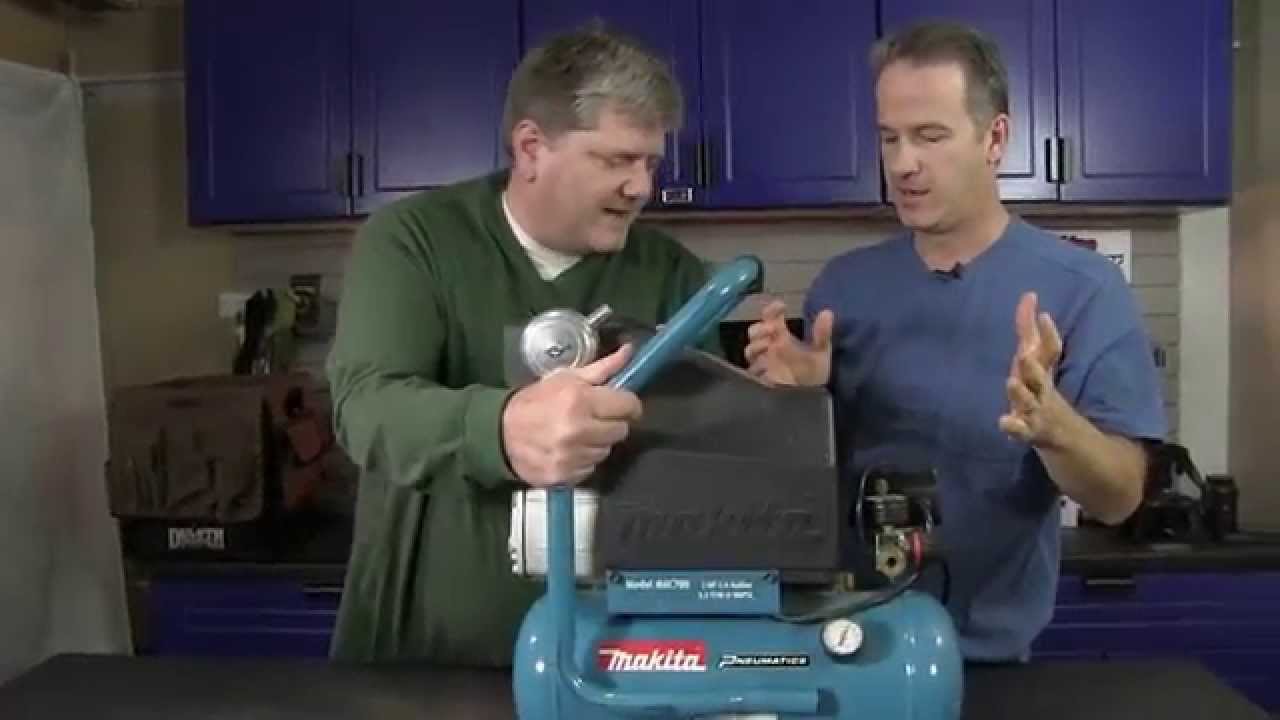
It’s time for another Handyguys tool challenge. On this show, the Handyguys take two very different compressors and run them through their paces. The listeners get to hear the difference between a small Makita MAC700 2 HP 2.6-gallon “hot dog” compressor and an older Porter-Cable compressor similar to the CPF4515 . Both compressors do a good job shooting framing nails into wood, but that is where the similarities end.

But does a handyguy or handygal really need a compressor? Is this something you need around the house? It all depends on the kind of work you will be doing. A compressor and pneumatic nailer are invaluable for trim work, crown molding, and framing. If you are going to finish your basement or have significant trim work around the house to complete, get a compressor. It will save a lot of time and hassle. For those weekend warriors, a compressor can’t be beat.

There are two basic varieties of compressors: oiled and oiless. The advantage of an oiless compressor is simpler maintenance — no oil or oil filter changes and no mess! However, the oiless compressors are generally very loud. While the oiled compressor is easier on the ear, they must be kept close to level at all times so the piston can be lubricated properly.

The other major differences between compressors is the tank size. The larger tank compressors can power tools that require large volumes of continuous air such as impact wrenches, grinders, and some paint sprayers. Pneumatic nailers use air in short bursts and can normally function well with smaller tanks. The smaller tanks are also much easier to move around. A large 20-gallon tank will not be very handy to move around the house to nail in baseboard trim.

So for about 90% of most household projects, the Makita MAC700 is the compressor to get. It is built like a tank, yet it does not blast your ear drums when the motor kicks in.

Once you get a compressor, you will need to get some pneumatic tools. There are hundreds of options. Normally you can just add some air tools as you need them. Typically you will start with a finish or framing nailer. For framing nailers, we like the full head framing nailer from Porter-Cable. There are generally two kinds of framing nails — clipped heads and round heads. The clipped heads have a “D” shape and allow you to get more nails within a clip. The downside is that some local codes do not allow the clipped heads. This is particularly true in hurricane prone areas. The round head nails look like typical nails.

Typical finish nailers include the 15-gauge angle nailer, the 16-gauge, and the 18-gauge. These nailers are great for baseboard trim, window casing, and crown molding. In addition, the 15-gauge can be used for hanging doors. The 15-gauge is the biggest, and it has a larger rectangular head which provides better holding power. Unfortunately it leaves a more drastic hole and requires more putty and sanding to hide the mark. The 18-gauge is the thinnest of the three and barely leaves a mark when it is nailed into finish trim. As a result you will not want to use it on heavy wood such as large crown molding.

For more information on compressors and nailers, tune in to this week’s Handyguys podcast.

Sphere: Related Content

Episode #4 - Get Organized

User ImageThe Handyguys February 7th, 2008

 
icon for podpress  Episode #4 - Get Organized [18:21m]: Play Now | Play in Popup | Download

The Handyguys talk about two big topics in home improvement today: a house that is “green” and a house that is organized. First is a discussion of a new product called the GreenSwitch. GreenSwitch is a wireless system that allows you to control several electrical switches and receptacles with a single switch. This switch provides an easy method to turn off all unnecessary lights and other electronics, thereby saving energy. You can even connect a thermostat to the switch to automatically set it to your away set-back mode to conserve power.

The Handyguys like GreenSwitch, but the price is steep. They would love to see technologies such as GreenSwitch and other wireless home automation and security products a little more integrated. You can find out more about what the guys think about this new technology on the podcast.

The other popular topic is home organization, which applies to garages, pantries and closets. Paul is getting ready to start a project on his master bedroom closet. It could use some attention, and his honey wants him to organize the space with some new shelving. Paul could probably build some shelving himself, but his honey-do list is long and he wants to get this job done sometime this year. At the same time, the budget is tight, so outsourcing this job to a custom closet company may be out of the question. What do you think he should do? Check out the show for details on how you can help!

Sphere: Related Content